Belief

19. WHAT I REFUSE TO BELIEVE

IMAG1529

Some time ago I posted an entry designed to better introduce myself called “WHAT I BELIEVE”.  It was only half of where I stand; this completes the circle. There are common convictions many endorse that I refuse to. They hinder advancement and are useless. I choose to embrace only those philosophies which lead me away from chaos and destruction.  My goal is to live a life of peaceful constructiveness. This is NOT a path of religious sentiment nor is it the result of following a singular teaching; it’s a journey of being faithful to my spirit. I trust in guidance from an inner place. I’m not referring to that loud obnoxious voice, the one wanting nothing but pleasures of the body, known as the ego. No, I speak of an almost silent whisper coming from the deep chambers of my soul. There is where I listen, getting what I need without asking for direction. This connection has served me well and I look forward to seeing where it will eventually take me.

I refuse to blame

I refuse to believe there is never a choice.

I refuse to believe in luck.

I refuse to believe the world is getting worse.

I refuse to believe I am a victim.

I refuse to believe in seduction.

I refuse to believe the past equals the future.

I refuse to believe that there’s somewhere where God is not.

I refuse to believe that there are those beyond hope.

I refuse to believe in ugliness.

I refuse to believe I am separate from God.

I refuse to believe in impossibilities.

I refuse to believe good guys finish last.

I refuse to believe in death.

I refuse to believe first impressions.

I refuse to believe that I can’t make a difference.

I refuse to believe  negativity.

I refuse to believe I’m given more than I can handle.

I refuse to believe I cannot change.

I refuse to believe in fear.

I refuse to believe in imperfection.

I refuse to believe violence is an answer.

I refuse to fight against anything. (I will fight for something though)

I refuse to be offended.

I refuse to be late.

I refuse to stop being just a bit juvenile sometimes.

I refuse to let a day go by without trying to make someone laugh.

I refuse to be an example of what not to do.

I refuse to sell myself short.

I refuse to complain.

I refuse to do something I know I’ll regret.

I refuse to leave this world wondering what I could have done better.

I refuse to not check for toilet paper before I sit down.

I refuse to try to impress people.

I refuse to let other people’s opinions change my opinion about me.

I refuse to ever stop growing.

I refuse to ignore my feelings.

I refuse to think I’m always right.

I refuse to hate.

I refuse to ignore a cry for help.

I refuse to be unkind.

I refuse to be lazy.

I know what I don’t want because at some point I used to practice these, and they almost destroyed me. As time goes on I’m sure I’ll purge more beliefs and habits. Humble pie tastes terrible but it sure does a good job of cleaning me out.

Please follow my blog. Comment and share as you wish.

With Love and Compassion, Daniel Andrew Lockwood

18. BEING TOUGH

00000000000000000000000000000

When I was young I got into a lot of fights. I don’t recall ever starting a single one. They were all  reactionary. It always took a lot of shoving before I finally shoved back. I never threw the first punch; didn’t really have the guts for it. This isn’t to say I wasn’t an instigator of sorts. I was self-centered, loud, opinionated, and downright strange. My attitude and behavior rubbed many the wrong direction. I never felt as if I were being a jerk nor was I conscious of how disruptive I could be; it’s just that my manners didn’t always put others first, something I eventually learned, thank God.

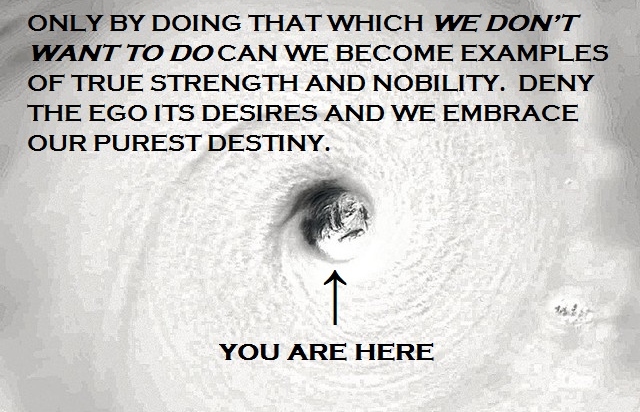
The desire to solve situations from a state of anger is the easily one of the most common routes traveled, especially for men. From playgrounds to the world stage we are witness to its evidence on a daily basis. There are other ways with similar properties, laziness, ignorance, apathy, victimization, and so on. These paths are so worn that very little grows here. Do not take this metaphor lightly. Truly, when  we embrace the easy routes, nothing will manifest towards challenging us to be better. We think it’s tough to put up a fight, stand our ground, and defend what we believe in. Upon the contrary actually. The REAL way to personify toughness  is to walk away from a fight, change our minds, and  defend those we don’t agree with. To be tough, really tough, we must do those things that are actually tough to do.

When I began the journey out of my fog, my mentor asked me what I wanted to accomplish from the challenges that lay ahead. I stated my goal was to prove to him just how tough I could be. He said that was my ego talking; it wasn’t. I knew that a truly better life was something not very many choose to pursue. The way was never clearly marked, but the promise of capturing something few could claim to own was all the invitation I needed. What I speak of is a life lived in constant conscious improvement. I refer the triad of existence – mind, body, and spirit. Feed these three the proper nutrients and they will both grow and serve. Personally my list is rather clear. Every day I seek to become a little more healthy, informed, kind, productive, empathetic, honest, etc. Please notice the qualities I have sought to expand are my interior ones. I focus NO energy at all on such things as a bigger car, increased power, more money, or a better reputation. These pursuits are, believe it or not, the easier way. They may seem difficult at first, but when compared to strengthening the point of origin, they’re child’s play. I have nothing against a better exterior, but in order for it to be fulfilling, at least to me, it must be the result of living from the inside out.

I dare you to go forth and become the toughest person you’ve ever met. Drop the need to be right. Be in a constant state of politeness. Look the homeless in the eye and smile while you think a kind thought. Be willing to give without expecting or asking for compensation. Learn a new language. Defend the absent. Ask for help. Learn how to play an instrument. Read Shakespeare. Show your emotions. Throw or give away all the stuff you don’t use anymore. Stop complaining and start praising. Do these things sound tough to do? Damn right; some of them for some, all of them for others. Obviously the list could continue with a plethora of examples.

There are a few ways to determine your toughest route, so try these suggestions.

  •  Make a list of your fears.

      Decide to, one at a time, eradicate irrational fears. They serve nothing and take up too much room in an already crowded life. Not wanting to enter a dark alley in a bad part of town is a rational fear. That little spider on the counter top poses a zero threat, really. This is an irrational fear.

  •  Recognize that we see ourselves in others.

     This is literally the fastest way to pinpoint what needs improving. Don’t believe me? Try leaving for work with plenty of time and see if the traffic is even slightly annoying. When you are late those who are also late will get in your way. When you’re early you won’t care who’s late (or thoughtless) around you.

  •  Pick a mentor.

      All of us admire someone. Most of us know at least one person no wind could move. They are at peace in any situation. They probably have a good deal of abundance in their lives that reflect upon both themselves and their environment. There are of course others in the public eye that can be looked to with the same definition. Remarkably, many of these people choose to share and teach how they remain in an unwavering attitude concerning their commitments to a better way of living. Mimic their behavior and you will reproduce similar results for yourself.

  •  Slow down somewhat and choose a noble course of action.

     When we give a little more time to allow ourselves a choice of actions (rather than the habitual or instinctive ones) we open a window to view alternative courses. I feel we almost always blindly choose the easiest (or perhaps most commonly used) method for approaching  how we “take offence” or “present defense.” For instance when someone insults you, try saying that you were just about to remark on the nice shirt they were wearing. Nothing like water to put out a fire.

  •  Embrace the idea of sacrifice.

   There is no reward without the intent of sacrifice. When time is needed to accomplish what must be done, some leisure activities are usually forfeit. When money is needed to seed an idea, frivolous spending must come to a stop. When weight is to be lost, chocolate must stay in the candy isle. Most people are reluctant to give up pleasure and replace it with what they think might be pain, but it’s all relative anyway. The idea of sacrifice can easily be equated with taking chances. This attitude can keep us in a falsely labeled “safe zone”. How many chances have you taken that improved your life? How many chances have you not taken that ended in regret? The opposite is true of course for both sides, but let’s be honest, taking chances is always far and away the more positive route. Ask yourself these questions, and you’ll see why it’s vital to occasionally step away from where you’ve convinced yourself your comfortable.

  • Stop looking backwards while walking forward.

     Take your focus off what might repeat itself from and place your attention on the future. This is how to envision and motivate real change. When we choose to see only what’s behind us, constantly fearing the past is doomed to repeat itself, any kind of  progress is going to be labeled as luck, or even worse, we’re going to feel unworthy of reward. Walking one way and looking another may gain a tiny bit of road, but in the end it will eventually cause a major accident. A life lived reactivity is the way of cowardice. It’s filled with excuses like “what if?” and “how come?” An active life defines true courage. Excuses do not exist here; trust, and determination do. This does not mean we should move forward without at least a rear-view mirror. Reminders of where we don’t want to be can put a little more speed in our progress, just don’t stop looking ahead.

So…..are you tough or easy? Me? I have both characteristics just like most, but the proof that I’m a lot tougher than I used to be presents itself as unexpected abundance, something I’m confidant will never stop expanding.

Please follow my blog. Comment and share as you wish.

With Love and Compassion, Daniel Andrew Lockwood
15. TAKING CHANCES

grey-skies

When I look back on my life and attempt to decipher the miraculous way it has interwoven itself to this point I see nothing I would change. The moments of misery that had me on my knees, begging for release, are the greatest gifts I own. Would I want to relive those epiphanies again? I would rather crawl naked up Mount Everest on broken glass, so the answer is a resounding no. It does however go to show just how powerful a true lesson can be. Knowing what we must avoid can sometimes be much more valuable than focusing on what we want to align with.

Almost all of my misery came from the habit of repetition. Einstein said “Insanity is doing the same thing over and over again expecting different results.” My insanity was compounded by the idea that if I repeated myself enough, I’d create better results. Funny thing was, I did manage (just barely) to do just that. Almost died because of it though, so please, try to put on the brakes a little earlier that I did. Once I finally started moving out of my spiraling decay, I found a way to embrace life I had never considered before. Death was so close at one point. The sunset of my life had almost turned my entire world black. Only a matter of weeks were left for me, and I made one last attempt at redemption. With nothing left to lose, I decided on an action I had avoided all my life based mostly on a fear of the unknown. I decided to start taking chances.

A sure thing is by no means a guarantee of reward. All it promises is a life without surprises, challenges, or excitement. When the future is somewhat foreseeable, be it good or bad, a process of planned response becomes embedded in our programming. Every day is dull and predictable. There is a need for predictability in our lives or we couldn’t function, but it’s the moments of the unexpected that always lead to the memories we cherish the most. Without these forks in the road we have no signposts pointing to what might be either a more beneficial path or one better avoided. Life is meant to be an adventure. Those who have made history, those we’ve read about and remember the most, are the ones who–when a new path that looked interesting opened up–took it without hesitation. Reward comes not just with risk but sacrifice of the self. The willingness to leave old ideas, old habits, and old pursuits behind is what frees us to move faster and freer towards a better tomorrow.

I’ve never taken a chance I’ve come to regret. It’s happened so much over the years that I actively seek new situations. I’m picky about them, but I choose many nonetheless. On the other hand there have been countless times where I’ve avoided taking a chance and have come to regret it, though the days of doing this are long behind me.

I believe life is lived better without ever asking “what if?” I don’t give myself permission to wonder what might have happened anymore. Do fear and caution accompany many such endeavors? Absolutely, but it’s always temporary. The anguish of knowing I missed out on a better opportunity has the potential to last an entire lifetime. Feelings such as these are the foundation of stagnation and remorse.

Please, whatever you dare to conceive, whatever you think is impossible, whatever seems hopeless, you must take a chance. No more wondering if you have the potential, no more wondering if you have the fortitude, no more wondering what others will think, and no more wondering how things could have been. If all of us were to step into our dreams and carry them forward into reality, this world would be the paradise only envisioned in literature. The proof that this is true is that paradise exists already for those who live in a world of chance. It’s too bad they stand out so prominently. I intend to be one of them.

With Love and Compassion, Daniel Andrew Lockwood

12. ADVICE FROM THE GROUND FLOOR

delorean-back-to-the-future-610x287

If you want to fast track a higher quality of life there’s a shortcut most will totally ignore.

STOP. BEING. LATE.

The habit of being late is the same thing as saying “My time is more valuable than yours.” As far as I’m concerned there’s no argument for this. If you go to the same place to work for years, and are late again for the four hundred and thirty-seventh time because traffic the sucks, I’ve got news for you pal, it’s NOT the traffic.

As far as the subject of self-help goes, it doesn’t get any more basic than this. Punctuality is in reality, rare. This is true because all of us instantly know those who are always prompt, and they do indeed stand out. The generalized identify of this trait is nothing more than showing up ahead of schedule. Few realize it also indicates a willingness to stay longer. There’s no doubt all of us want more time, but what good are a few extra minutes if they are not productive and peaceful? Why subject yourself to a lifestyle of constant rushing to get out the door when all one has to do is start earlier?

Early in my recovery I was clonked over the head repeatedly with this topic, and for good reason. The habit of tardiness is basically one of self-centeredness, and boy did I have buckets of ego. Along with the action, I also had a filing cabinet full of excuses to accompany my behavior. There were some pretty creative ones too. My personal favorite (at the time) was claiming I’d been pulled over by the cops for some minor infringement. I’d tell my inconvenienced audience that they were nice and let me go with just a warning. Not only was I lying about why I was late, I was attempting to generate sympathy for myself as well. Using lies like this to perpetuate my laziness turned my mind into a garbage dump. My collection of lies and pointless excuses eventually took up so much mental room, there was little left over for even the most basic of needs. It finally became clear the only thing I could be counted on to do was to be unreliable. I eventually turned this lifestyle around by realizing all that was required to change it was to walk away from it. No clean up was necessary, just abandonment.

When I came to the conclusion I had no need to drag the past into the present, it allowed me the freedom to move forward without attachment to previous behavior. Over the years I’ve practiced a lot of habits I’ve vowed never to repeat. These slips of character are not who I am; they exist only as memories to help me define what I am not. I did not want to be the last person to show up anymore, and I had plenty of examples to use as leverage to help me to change that. I left a broken lifestyle behind and went forth with a willingness to do what would be asked of me from those I had wronged through my sloth.

It’s just my opinion, but I think a lot of the world’s problems would disappear if everyone would just make a commitment to show up on time. Traffic would ease, health issues due to stress would lower, production would rise, and trust would increase; all because of one thing changing. It may be a fool’s wish, but I’m sure it’s one that can be clearly envisioned by most of us.

There are some habits I’ve developed that help to nurture a more reliable (and relaxing) lifestyle.

  1. When I wake up, I choose to get up. If the thought enters my mind that I would like to sleep some more, I replace it with, “Wake up.” When my mind hears a request from the conscious part, my sub-conscious part (which is still driving the bus)  responds and starts the chemistry that makes me want to get out of bed rather than stay there. Let’s face it, five more minutes, or even a little more, makes almost no difference on a complete night’s rest anyway.
  2. I do my best not to leave anything undone at the end of my duties that I don’t want to do upon returning. In other words, at the very least, I’ll give myself something to look forward to “not doing.”
  3. IF a delay really does come up, I will inform those waiting on me as soon as possible. If I tell someone ahead of time that my behavior is going to be disruptive, there will be no need to excuse it later, and that earns respect.
  4. Rest is a priority to the expenditure of energy. I try not to short-change myself in this area. It does seem that the older I get, the earlier I go to bed, and the earlier I rise– which automatically gives me what I need.

I do not follow these ideas as strictly as I would like. The only one I don’t break is the third one. Yes, I am still late on occasion. I am not without fault here, but I am much more aware of others who are waiting for me, and that has allowed a less-selfish approach to the day. It sounds simplistic, but the bottom line to curing a tardy life is nothing more than choosing to give yourself enough time.

It has been my experience that reliability equals abundance, and this was the first step I took that opened those floodgates. If nothing else, the more we are late, the more we miss out on life, and I for one don’t want to miss a thing.

Please follow my blog. Comment and share as you wish.

With Love and Compassion, Daniel Andrew Lockwood
11. ELIMINATING REGRET

regrets

In my post “What I Believe”, there is an affirmation that says “I believe in doing the most, what I’ll regret the least.” This philosophy goes hand-in-hand with the statement: “I believe regrets are grudges I hold against myself.” These two ideas are like bookends that keep the direction of my life organized, upright, and on purpose. My past has proven that the presence of regret equals an urge to manufacture excuses. Once I’ve done something I knew wasn’t supposed to, I’d feel compelled to justify why it happened, leading to a defensive posture. As soon as I’ve done something someone else knows I shouldn’t have, and they point it out, I’ve been known to take an offensive stand. Both times I’ve sought to excuse my behavior.

I live my life in two modes, action and reaction, or offensive and defensive. They have their place, but one should not be favored over the other. They compliment with strength and harmony when properly mixed. The people who do this skillfully lead well-adjusted lives. They are easy to pay attention to and quick to listen. A balanced approach attracts, while the unbalanced delivery repels.  No one likes those who are too defensive. Neither do they take kindly to those who are overly offensive. People who play the defender claim to be constantly victimized, and those who play the offender claim to be forever insulted. In either case neither person generates respect or trust from those around them. Each example must come up with constant excuses in order to continue their theatrics, or the behavior will not persist. I should know, I’ve visited the two sides with great frequency over the years.

If the erasure of regret equals the disappearance of excuses, then I say bring it on.  Without regret, I cannot own or operate being either patsy or aggressor. This does not mean I’m not opinionated or that I won’t stand up for what I believe that is right and good. What it does mean is that I’ll move forward with the attitude of doing the most what I’ll regret the least. When I find myself at an intersection, the only question that must be asked is, “what will I regret doing?”  I then avoid moving in those directions. As soon as I choose a lesser way, and create regret, then I begin to hold a grudge against my own actions. Those actions that we hold grudges against, we feel the need to punish. If I do the same to myself, then I’ll inevitably seek out some sort of punishment–mostly unaware I’m even doing it. This is a primary root of self-destructive behavior. ALL self-destructive behavior needs excuses to survive, so it stands to reason that it will consistently choose the lesser of two (or more) destinations in order to perpetuate its existence.

When I feel the impulse to defend, I do my best to use it by helping someone else, especially if they are not present. I’ve noticed people are more willing go into attack mode when there is no chance of retribution from the focus of  their argument. Rarely will I defend a personal agenda. If what’s being threatened is my safety, only then will I not hold back. On the other hand, I’m rarely offended. I’ve chosen a few items over the years I want changed, and these I’ll let offend me. Nothing gets better unless I become dissatisfied with how things are, so this attitude is useful when an action follows that’s designed to improve something. I never do anything that undermines someone else’s quality of life just so mine can get better. Looking at both actions, I will of course avoid doing anything that would lead to a regret.

I think all of us have had episodes of supreme confidence. When I’m in these moments I move forward without complaining or explaining. No excuses, just action. “Don’t complain, don’t explain” is a very famous and useful saying. It helps eliminate other people’s opinions, bad OR good, and keeps me focused on the task at hand. When the thoughts of others are eliminated, then there’s no need to argue (defend) or no need to listen (take a chance on being offended.) There are, of course some people in my life I want feedback from, but there are VERY few.

All I know is, I’m not going to be laying in my death-bed and allow the last words of my life begin with the line “It’s too bad I didn’t…..” A life lived without regret is one of the greatest freedoms we can seek. It’s absence serves to eliminate pain and helps to invite serenity.

Please follow my blog. Comment and share as you wish.

With Love and Compassion, Daniel Andrew Lockwood

9. THE RIGHT QUESTIONS

blue

A higher standard of living is a wonderful thing. Who doesn’t want better health, a greater income, stronger relationships, better outlooks, and happier moments? This utopian existence isn’t a fantasy. As a matter of fact, it’s not that difficult to manifest. All it usually requires is a shift in patterns of thought.

When I receive anything, it’s by the appearance of only two possible outcomes–I either get what I want, or I don’t.  I’m well aware that my thoughts equal my reality. Everything that surrounds me has appeared because I have desired it. The desk I’m writing upon, the clothing I’m wearing, the music I’m listening to, the health I enjoy, the love I know–all of these are here because I wished them here.  If my reality becomes unsatisfactory, then my thoughts must be in line with whatever has become unwanted. Allow me to clarify this before  it starts sounding a little too weird.

My quality of life equals the quality of my requests. To put it simply, better questions equal better answers. When my world was a garbage dump, it was because I collected nothing but trash. The “why me?” brand of questioning produced all kinds of unwelcome results, and since I had no idea I was doing it, I kept it up. When I asked “why am I fat?, why am I lonely?, why am I poor?, why am I an addict?”, I got a lot of answers.  The answers all served to re-enforce the original idea. In essence, what I kept asking gave me more reasons to keep asking the same questions; since I was repeating myself, the answers would compound. For instance, the question “why am I so fat?” would produce replies that sounded something like this, “you’re so fat because you’re lazy, eat crap, don’t exercise, and have no will power.” When I convinced myself that I had logical reasons to keep up my behavior, I had no leverage to stop it.

Nothing changed until I shifted my questions. The brain is a remarkable machine. Almost any problem conceived will require it to produce some sort of feedback. When I started focusing on the opposite of what I’d been fixating upon, miraculous transformations began taking place. The idea of finding solutions rather than problems was an old idea, but one I had never really given much thought to. This may sound simple, but I assure you, it’s a powerful tool. The opposite of “why am I fat?” wasn’t “how do I lose weight?” This is because the idea of being heavy still persists in the question. It’s true opposite is “how do I get thin?” While this is indeed a higher quality question, it can be energized to force the brain to find the BEST solution. “What’s the healthiest way to get thin and have fun doing it?” Now THERE’ a great question.

The pattern to the elimination of this self-destructive behavior hasn’t failed me yet. These are the steps I take.

  1. If I have results in my life that are opposite of what I really want, I recognize that somewhere a wrong question is being asked.
  2.  I identify the question.
  3. I flip the idea to the highest or most positive outcome I want.
  4.  I take action. This often includes asking for advice or assistance.
  5. I actively appreciate–not just by thanking others, but also by allowing gratitude to be extended to myself.

Please keep in mind that I’m not necessarily talking about the “stuff” in life improving. The material part of my existence has always reflected my mental initiative, so my focus has remained on shifting my attitude. I believe that whatever I expect, I create. One thing’s for sure, I’ve done exactly that so far. All the pain and all the pleasure that has come and gone in my life has either met or exceeded my expectations.

Please follow my blog. Comment and share as you wish. 

With Love and Compassion, Daniel Andrew Lockwood

8. MY FAVORITE BUMPER STICKER

Sunset_2007-1

I had this bumper sticker printed up years ago and handed them out for free to anyone willing to take one. While it still makes me laugh, I also consider it a very important question.  It’s a little like hearing someone complain about whiners. Not only are they joining in with the same crowd they are trying to distance themselves from, now they’re center stage. I think this is why we should “Love thine enemy as thyself.”

If tolerance is what we want to project, are we not obligated to turn this attitude towards those who receive it the least? When mankind experiences pain somewhere in its “body” shouldn’t this demand care and healing? We seem to point towards what isn’t working in our society and do our best to fight it rather than help it. We praise that which is already doing well and insult what isn’t functioning properly. In my opinion this attitude is destructive and immoral.

No one wants to be around a hypocrite. People that do this are fooling themselves into believing that by putting everyone else down, they don’t have to work at doing anything to look good. We witness this unethical “sleight-of-hand” all the time in various incarnations. The “I’m right and everyone else is wrong” syndrome is, unfortunately, very common.  “No one does what I tell them to do” equals “I’m perfect, they’re flawed.” “No one comes up with better solutions than me” equals “I’m brilliant and they’re stupid.” “Others don’t do nearly as much work as me” equals “I’m productive, they’re useless.” “Everyday I fight bad drivers on the way to work” equals “I’m courteous, they’re rude.” All of these are hypocritical attitudes. No one is perfect. This is not a generalized judgment; I simply mean that there is always room for improvement.  The trap of thinking you’re beyond reproach is to invite a lifestyle that will convince itself there’s no need for progress.   Those who try to position themselves into a brighter spotlight by negative promotion lose all credibility. They don’t realize their audience is  instinctively aware that they’re unwilling to become better.

I would love to think I am past this kind of behavior but I’m not. On occasion I catch myself playing the victim. My moments of “poor me” are a lot less pronounced than they used to be, but at least I have the ability to recognize them. This “role” leaves a bitter taste, I assure you.  I’ve learned  there are countermeasures for this habit.

  1. I stop trying to be better than the rest of the crowd, I simply commit to being better than I used to be.
  2. My personal standards are far beyond what others expect of me.
  3. I acknowledge where talent lies. When I’m seen as someone who gives credit where credit is due, I notice people are more eager to work as a team. Everyone wants some sort of recognition for their contributions. Sometimes nothing more than a “Thank You” makes all the difference, especially when it’s done in public. I know it does for me.

I think it’s amazing just how many don’t do this. It’s too bad that the ones who do this stand out so prominently. They are a rare breed; I wish they weren’t.

Please follow my blog. Comment and share as you wish.

With Love and Compassion, Daniel Andrew Lockwood

3. HOW TO KNOW IF YOU ARE ON THE RIGHT TRACK

maze-primary

Sometimes, when we look toward that which we desire most, there seems to be an impassable labyrinth of nettle and pitfalls between where we stand and where we want to be. The potential journey seems so overwhelming that we simply never start no matter what  reward awaits us on the other side. Those who have made their way through this obstacle course will always tell you it was worth it. Desperation often equals determination, meaning that those who have nothing to lose will attempt anything to gain something. This does not necessarily mean one must hit bottom before making an attempt at a better life.

If you are willing to step forward into this unknown, there are three things I can suggest you to do that will at least let you know you’re moving in the right direction.

First– Follow the voice of someone on the other side.

What this means is that you cannot take navigation from those standing next to you. They don’t know the way any more than you do. Call out for guidance. Someone will always answer, but this doesn’t mean they are somewhere you want to be. These people must have in their lives what you want in yours. The best you are liable to get from them is the best they have to offer. Scrutinize and question, so you can be led by the elite. Once you have set foot on the proper path, your chosen leader will be able to see you, but you won’t be able to see them, so following instruction is critical. Here, where the next step is often obscured, we are not allowed to question the voice. Trust is absolutely necessary or progress will not manifest. If you do step in a direction of your own choosing, your guide will most likely lose sight of you, and starting over is often the only option. This isn’t necessarily the end of the attempt, but if you start over too much, your mentor will likely give up in favor of someone with more determination.  Keep in mind that others are waiting in line behind you for that same voice to lead them through the thicket.

Second– Allow criticism.

We cannot improve by repeating the same patterns of behavior that keep us bound to that which we no longer want. As I stated in the previous step, we must receive direction from those who have a high quality of life. This means we are going to get a lot of instruction on what must be abandoned. Old behaviors and thought patterns will have to be eliminated, while new skills and ideas will be offered. This will come in the form of criticism. There is a way to take it with honor and grace. You must drop the need to defend yourself and realize no one who truly cares for you will say anything that is not based in love. It won’t feel good at the moment, but being open to this is absolutely necessary.

Third– KNOW that you are probably going to get pissed at those who are telling you what to do.

I was blessed with the intuition this was probably going to happen no matter what. It did indeed come in torrents, but when I knew ahead of time that this emotion was a constant  potential, it didn’t feel nearly as bad as I knew it could have. When I first quit drinking I spent an entire year angry. I never let it disable me though.  I always took what was said as the truth, no matter what; which meant I was wrong a lot. Basically, I was mad at myself and this only served to continue renewing my determination to stick to the path.

These three steps can be applied to any area of self-improvement you wish to develop. Look to the skills you already possess. It will become clear this process automatically took place. Everything we learn, from driving a car to pursuing a martial art, will involve asking for and taking guidance while allowing for evaluation of our progress. Keep in mind I am not talking about becoming self-taught at any particular skill; one can go only so far with this attitude. I’m speaking of becoming a master at whatever we choose to focus on.

That’s it. This the best map I can offer on the subject. I know it’s not much, but it’s a heck of a lot better that proceeding with earplugs and a blindfold.

Please follow my blog. Comment and share as you wish.

With Love and Compassion, Daniel Andrew Lockwood