Goals

38. A PERFECT WORLD

earth12

Ask yourself this question…

“Would mistakes ever happen here if humans weren’t on the planet?” We are the only creatures that live, suffer, and die by our OWN judgments; our own egos. How many of us in history have laid on their death beds full of regret and remorse? How many of us have died with un-planted seeds that could have changed the world? How much potential has been ignored, given up on, and forgotten? Please choose to be what you can be, and do not leave this world with dreams unexpressed.

Please follow my blog and comment as you like. I will answer all.

With Love and Compassion, Daniel Andrew Lockwood

35. PLEASE STOP BY…..

open

Welcome!

I write a blog dedicated to the subject of ground-floor self-help topics. My introduction says a lot about where I come from and who I am. Further subjects address different areas of interest. I’m looking for new subscribers and will respond to all who care to leave a message.

With Love and Compassion, Daniel Andrew Lockwood

32. “The right …

“The right lived life does its greatest work in the final hour.”

I invite new followers and will respond to all comments.

With Love and Compassion, Daniel Andrew Lockwood

31. “We cannot be …

“We cannot be motivated to rise to greater heights without first exploring the depths of what must be avoided.”

With Love and Compassion, Daniel Andrew Lockwood

30. COME ON IN AND REST A WHILE……

Please make yourself at home and know that here there is understanding, acceptance, and kindness. I have nothing to sell but a lot to give and share. Check my topics and see if anything resonates. I welcome you to please follow my blog. Feel free to comment, feel free to share, I will acknowledge all.

With Love and Compassion, Daniel Andrew Lockwood

25. ALL THE WORLD IS A MIRROR…

thinker (2)

I once met a man who acted exactly like me and I couldn’t stand him. This is the God’s honest truth. As I stood there slack-jawed, watching this person complain, blame, and throw a tantrum, I was both amused and horrified. His behavior was not just disruptive to his own agenda, it was interfering with the duties of those around him. As he flailed about it dawned upon me that all of his energy was being used on the opposite of what he said he wanted; getting the job done. I was a year and a half past my most self destructive behavior when this happened, and I was grateful for having witnessed it. I’d never been so stunned in my life. I was this man; selfish, self-centered, and looking for excuses in my environment that could perpetuate my behavior. I felt sick. I also felt fortunate.

Do I really feel we see ourselves in others? Yes. There is a way to use this observation to  great advantage, and it’s probably not what you think it is. Most people don’t want to openly admit their mistakes or flaws, preferring instead to keep a mental note of what not to repeat should similar situations arise. Fair enough, though the benefits of humility, trust, and respect will flourish when one is quick to admit error to those it has inconvenienced. Since it is rather painful to look at what annoys us the most and try to find that part of ourselves that aligns with what needs purged, I would suggest an entirely different path. Look instead to everyone around you and seek out what is good, beautiful, perfect, and pleasant. In turn you will subconsciously elevate those same qualities in yourself. There is no need to evaluate the “bad” in others when observing the “good” will benefit you more. Don’t get me wrong, just as the beginning of this essay pointed out, I was glad to discover what needed changed. I think it’s easy to see that if I were to be in  constant (negative) judgment, and then go on to justify this state of mind by announcing that I was in search of myself, my ego would simply take over and I would revert to thinking I couldn’t be nearly as “broken” as those I was witness to.

Do not the best of us also see nothing but the best in others? Do not the most negative see nothing but an imperfect and broken world? Think about that for a moment. History has its examples just as our own families and colleagues provide theirs. Consider this, I believe that redemption is available to the worst of us; because if it isn’t available to the worst of us, then is isn’t available to any of us. What this means to me is that there is good in everyone, and I mean EVERYONE. The harder we look for it in others the more we must express it in our own lives. This practice lends itself to a life of love, tolerance, forgiveness, compassion, and empathy.  All of man’s struggles seem to arise from the absence of these five qualities. Let’s not let the opposite determine our actions..

With Love and Compassion, Daniel Andrew Lockwood

http://dailypost.wordpress.com/dp_writing_challenge/worlds-colliding/

23. THE IMPORTANCE OF THE RIGHT QUESTION

questions

A few weeks ago I wrote an entry called “The Right Questions.”  This is a follow-up or companion piece to that article. Approaching life in this manner is a passion of mine, and I’ll most likely write about it again in the future.

When I first ventured towards new horizons, a different perspective of both asking and answering questions became necessary. The volume of my new-found form of analysis was more than I’d anticipated. Some examples were clear, and the answer obvious, and some were quite cryptic. The latter of the two was meant to free certain “mental” wheels that had been poorly maintained. When I was asked “What must I do to begin building up a life of reliability?” the solution was to stop being late everywhere. There was no doubt as to the meaning of this directive, and there was no uncertainty as to the outcome of its implementation. The answer came quickly and was easy to understand. On the other hand I was frequently given nothing more than the answer with instructions to search for the question. One such example was “You limit yourself because you have a fear of success.” Quite often my goal was to come up with the question that fit the answer. Eventually I did, and the question was, “Why do I avoid responsibility?”  In any case, the quality of my life improved with the quality of the questions that were being asked, either directly or indirectly.

One such question that drastically changed my life was, “If you knew you only had an hour to live and if you felt good and weren’t scared, What would you do?” It’s an old  point of discussion and I’ve heard it before, but I’d never meditated on it. Once I did, my outlook on life shifted considerably. Basically I’ve gotten two answers from those who were sincere in coming up with an honest reply. Some say prayer and silence would be their choice. This is a minority answer, and I consider it an extremely enlightened one, but maybe one in twenty will state it. The majority say something like, “I would use part of my time to thank those whose lives have made mine better. Whatever was left over I’d spend in the arms of the person I love the most.” My personal response probably lies here. It’s an interesting question because no one says “I’ve only got an hour, maybe I should clean the house, or mow the lawn, or go to the bank, or even eat.” Nothing material is attached to where true value lies. Nothing. This is but one example of a high quality question.

Most seek nothing but answers when their true quest should be identifying the correct questions. My mentor used to say, “There are no right answers to the wrong questions.” If you say to the ether “Why me?” you will get lots of answers that do nothing to empower you. In return you’ll get plenty of information designed to reaffirm why you are in a place of undesirability. Logically, if the original inquiry is producing unwanted answers, then should not the opposite question produce what is sought? Try asking instead “Why NOT me?” If you want to lose weight the opposite of “Why am I fat?” is NOT “Why am I not thin?” This is the same question in disguise. It’s true opposite would be “How can I get thin?” Subtle; yes, but believe me the brain knows the difference and it will eventually churn out what is asked of it.

Subconsciously (and of course consciously) everyone has conversations in their minds designed to eliminate what is wanted and manifest what is desired. The problem with unintentionally attracting what is unwanted lies in how we word our thoughts. Think about it. If you constantly ask yourself why are you passed by for promotion you’ll get answers that are riddled with blame rather than accountability, and these will only serve self-defeating behavior.

There are several ways to stop the habit of asking bad questions.

  1. Stop saying “why?” and start saying “how?” It’s a one word change that will produce instant results. When “why” is the driving force of a question, you will generate excuses. When “how” is used instead, you will generate solutions. By the way, don’t revert to “how come?” That’s just another “why” in disguise.
  2. Stop asking yourself questions better answered by a more qualified source i.e. “How do I stop drinking?” The use of the word “how” in this case will eventually force us beyond the limits of our own minds. When we embrace outside information (oftentimes masquerading as criticism) we open ourselves to unlimited choices, and isn’t that what we should have anyway?  Remember what Einstein said, “We can’t solve problems by using the same kind of thinking we used when we created them.” For me this means I have to stop re-arranging what’s in my own head convinced it will eventually add up differently. He also said that the definition of insanity was doing the same thing over and over expecting different results. It really comes down to listening more than talking; something I still struggle with.
  3. Start shifting your approach to life from one of doubt to one of expectation. This will automatically re-write how thoughts word themselves. Don’t generate anxiety, uncertainty,  or worry  about your goals; expect them and they will unfold. Get off the “what if?” ride and jump onto the certitude express. Remember, planning for the worst and assuming it are vastly different. Contingency plans are fine, but they must exist only in the background. Driving a vehicle without brakes and seat belts will force you to a crawl; whereas utilizing the car’s safety features will allow maximum confidence in both driver and machine.

Make a list of good questions and repeat them a LOT to yourself. If they are indeed high quality they will generate even more high quality questions. My top three are –

  • How can I become a better man?
  • How can I serve?

And..

  • How can I live without regret?

Please follow my blog. Comment and share as you wish.

With Love and Compassion, Daniel Andrew Lockwood
20. APPROACHING LIFE POLITELY

tr

When I was in second grade our teacher, Mrs. Larson, spent an entire day on manners. It made a great impression on me. I learned to open doors not just for girls, but anyone. I learned to say “Mr.” and “Miss or Mrs.” to those I approached (especially strangers) as a way of acknowledging someone with dignity. I learned to show a graceful respect for everyone no matter their appearance or age.  I’ve often wondered how far and to whom her influence has carried itself. Forty years later the ripples in my pond are still there.

I learned very quickly how important politeness is. Some think of it as an attempt at being self-centered or above reproach using such words as snotty, conceited, pretentious, or arrogant to describe this attitude.  I do indeed see how it  might be played as leverage to try and rise above others.  This is not the proper definition nor execution of what I’ve come to understand. Courtesy is the act of putting even the smallest needs for others first; always. This is easily understood when its opposite is realized. Those we know who are the most rude and cocky constantly put themselves first in every situation. They are unkind and impolite. Their self-perceived priorities take precedence. They are extremely unreliable in every situation because when the need for help arises, it’s given only when it benefits them as well.

Putting the needs of others first isn’t just the entire picture. I suppose one could do this outwardly while hiding feelings resentment and jealousy. I’m ashamed to admit that I’ve done this, especially in traffic, but I’m also happy to announce that these incidents are becoming exceedingly rare. Being polite isn’t about how I want others to see me, it’s about how I want to see myself. If someone else benefits from something I’ve done, it’s a side-effect, not the goal. I used to become frustrated when my attempts at being civilized weren’t being returned. Someone would yell at me until I finally sunk to their level and yelled back. Not anymore. Don’t get me wrong there are plenty of times where I will step up and be a MAN, raising my voice appropriately when the situation calls for it, but I will never be a jerk or insulting.

Do not think that politeness is equal with weakness. It’s not an invitation  to those seeking to take advantage of a peaceful situation. Upon the contrary, keeping a calm and patient exterior (as well as interior) lets nothing unwanted influence you.  Remember, frustration always commits suicide. It cannot survive without a captive audience so it self-destructs. As soon as its given attention it has a reason to re-assert itself which is why the followers of a great many historical blowhards are just as annoying as their leaders.

At the very least ask yourself these questions. Why not be kind? Why not be patient? Why not be empathetic? Why not be generous? Besides, who really does want to become rude, impatient, indifferent, and selfish anyway?

With Love and Compassion, Daniel Andrew Lockwood

18. BEING TOUGH

00000000000000000000000000000

When I was young I got into a lot of fights. I don’t recall ever starting a single one. They were all  reactionary. It always took a lot of shoving before I finally shoved back. I never threw the first punch; didn’t really have the guts for it. This isn’t to say I wasn’t an instigator of sorts. I was self-centered, loud, opinionated, and downright strange. My attitude and behavior rubbed many the wrong direction. I never felt as if I were being a jerk nor was I conscious of how disruptive I could be; it’s just that my manners didn’t always put others first, something I eventually learned, thank God.

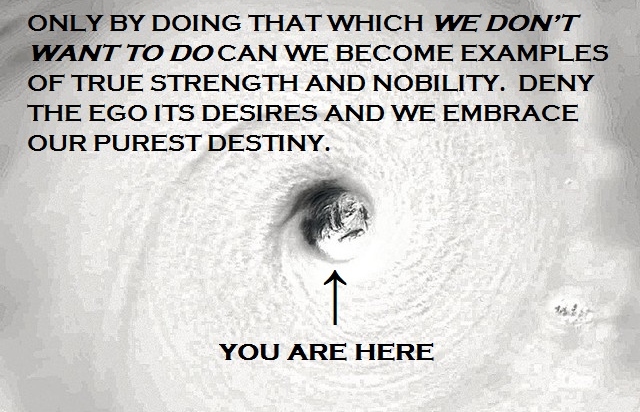
The desire to solve situations from a state of anger is the easily one of the most common routes traveled, especially for men. From playgrounds to the world stage we are witness to its evidence on a daily basis. There are other ways with similar properties, laziness, ignorance, apathy, victimization, and so on. These paths are so worn that very little grows here. Do not take this metaphor lightly. Truly, when  we embrace the easy routes, nothing will manifest towards challenging us to be better. We think it’s tough to put up a fight, stand our ground, and defend what we believe in. Upon the contrary actually. The REAL way to personify toughness  is to walk away from a fight, change our minds, and  defend those we don’t agree with. To be tough, really tough, we must do those things that are actually tough to do.

When I began the journey out of my fog, my mentor asked me what I wanted to accomplish from the challenges that lay ahead. I stated my goal was to prove to him just how tough I could be. He said that was my ego talking; it wasn’t. I knew that a truly better life was something not very many choose to pursue. The way was never clearly marked, but the promise of capturing something few could claim to own was all the invitation I needed. What I speak of is a life lived in constant conscious improvement. I refer the triad of existence – mind, body, and spirit. Feed these three the proper nutrients and they will both grow and serve. Personally my list is rather clear. Every day I seek to become a little more healthy, informed, kind, productive, empathetic, honest, etc. Please notice the qualities I have sought to expand are my interior ones. I focus NO energy at all on such things as a bigger car, increased power, more money, or a better reputation. These pursuits are, believe it or not, the easier way. They may seem difficult at first, but when compared to strengthening the point of origin, they’re child’s play. I have nothing against a better exterior, but in order for it to be fulfilling, at least to me, it must be the result of living from the inside out.

I dare you to go forth and become the toughest person you’ve ever met. Drop the need to be right. Be in a constant state of politeness. Look the homeless in the eye and smile while you think a kind thought. Be willing to give without expecting or asking for compensation. Learn a new language. Defend the absent. Ask for help. Learn how to play an instrument. Read Shakespeare. Show your emotions. Throw or give away all the stuff you don’t use anymore. Stop complaining and start praising. Do these things sound tough to do? Damn right; some of them for some, all of them for others. Obviously the list could continue with a plethora of examples.

There are a few ways to determine your toughest route, so try these suggestions.

  •  Make a list of your fears.

      Decide to, one at a time, eradicate irrational fears. They serve nothing and take up too much room in an already crowded life. Not wanting to enter a dark alley in a bad part of town is a rational fear. That little spider on the counter top poses a zero threat, really. This is an irrational fear.

  •  Recognize that we see ourselves in others.

     This is literally the fastest way to pinpoint what needs improving. Don’t believe me? Try leaving for work with plenty of time and see if the traffic is even slightly annoying. When you are late those who are also late will get in your way. When you’re early you won’t care who’s late (or thoughtless) around you.

  •  Pick a mentor.

      All of us admire someone. Most of us know at least one person no wind could move. They are at peace in any situation. They probably have a good deal of abundance in their lives that reflect upon both themselves and their environment. There are of course others in the public eye that can be looked to with the same definition. Remarkably, many of these people choose to share and teach how they remain in an unwavering attitude concerning their commitments to a better way of living. Mimic their behavior and you will reproduce similar results for yourself.

  •  Slow down somewhat and choose a noble course of action.

     When we give a little more time to allow ourselves a choice of actions (rather than the habitual or instinctive ones) we open a window to view alternative courses. I feel we almost always blindly choose the easiest (or perhaps most commonly used) method for approaching  how we “take offence” or “present defense.” For instance when someone insults you, try saying that you were just about to remark on the nice shirt they were wearing. Nothing like water to put out a fire.

  •  Embrace the idea of sacrifice.

   There is no reward without the intent of sacrifice. When time is needed to accomplish what must be done, some leisure activities are usually forfeit. When money is needed to seed an idea, frivolous spending must come to a stop. When weight is to be lost, chocolate must stay in the candy isle. Most people are reluctant to give up pleasure and replace it with what they think might be pain, but it’s all relative anyway. The idea of sacrifice can easily be equated with taking chances. This attitude can keep us in a falsely labeled “safe zone”. How many chances have you taken that improved your life? How many chances have you not taken that ended in regret? The opposite is true of course for both sides, but let’s be honest, taking chances is always far and away the more positive route. Ask yourself these questions, and you’ll see why it’s vital to occasionally step away from where you’ve convinced yourself your comfortable.

  • Stop looking backwards while walking forward.

     Take your focus off what might repeat itself from and place your attention on the future. This is how to envision and motivate real change. When we choose to see only what’s behind us, constantly fearing the past is doomed to repeat itself, any kind of  progress is going to be labeled as luck, or even worse, we’re going to feel unworthy of reward. Walking one way and looking another may gain a tiny bit of road, but in the end it will eventually cause a major accident. A life lived reactivity is the way of cowardice. It’s filled with excuses like “what if?” and “how come?” An active life defines true courage. Excuses do not exist here; trust, and determination do. This does not mean we should move forward without at least a rear-view mirror. Reminders of where we don’t want to be can put a little more speed in our progress, just don’t stop looking ahead.

So…..are you tough or easy? Me? I have both characteristics just like most, but the proof that I’m a lot tougher than I used to be presents itself as unexpected abundance, something I’m confidant will never stop expanding.

Please follow my blog. Comment and share as you wish.

With Love and Compassion, Daniel Andrew Lockwood

15. TAKING CHANCES

grey-skies

When I look back on my life and attempt to decipher the miraculous way it has interwoven itself to this point I see nothing I would change. The moments of misery that had me on my knees, begging for release, are the greatest gifts I own. Would I want to relive those epiphanies again? I would rather crawl naked up Mount Everest on broken glass, so the answer is a resounding no. It does however go to show just how powerful a true lesson can be. Knowing what we must avoid can sometimes be much more valuable than focusing on what we want to align with.

Almost all of my misery came from the habit of repetition. Einstein said “Insanity is doing the same thing over and over again expecting different results.” My insanity was compounded by the idea that if I repeated myself enough, I’d create better results. Funny thing was, I did manage (just barely) to do just that. Almost died because of it though, so please, try to put on the brakes a little earlier that I did. Once I finally started moving out of my spiraling decay, I found a way to embrace life I had never considered before. Death was so close at one point. The sunset of my life had almost turned my entire world black. Only a matter of weeks were left for me, and I made one last attempt at redemption. With nothing left to lose, I decided on an action I had avoided all my life based mostly on a fear of the unknown. I decided to start taking chances.

A sure thing is by no means a guarantee of reward. All it promises is a life without surprises, challenges, or excitement. When the future is somewhat foreseeable, be it good or bad, a process of planned response becomes embedded in our programming. Every day is dull and predictable. There is a need for predictability in our lives or we couldn’t function, but it’s the moments of the unexpected that always lead to the memories we cherish the most. Without these forks in the road we have no signposts pointing to what might be either a more beneficial path or one better avoided. Life is meant to be an adventure. Those who have made history, those we’ve read about and remember the most, are the ones who–when a new path that looked interesting opened up–took it without hesitation. Reward comes not just with risk but sacrifice of the self. The willingness to leave old ideas, old habits, and old pursuits behind is what frees us to move faster and freer towards a better tomorrow.

I’ve never taken a chance I’ve come to regret. It’s happened so much over the years that I actively seek new situations. I’m picky about them, but I choose many nonetheless. On the other hand there have been countless times where I’ve avoided taking a chance and have come to regret it, though the days of doing this are long behind me.

I believe life is lived better without ever asking “what if?” I don’t give myself permission to wonder what might have happened anymore. Do fear and caution accompany many such endeavors? Absolutely, but it’s always temporary. The anguish of knowing I missed out on a better opportunity has the potential to last an entire lifetime. Feelings such as these are the foundation of stagnation and remorse.

Please, whatever you dare to conceive, whatever you think is impossible, whatever seems hopeless, you must take a chance. No more wondering if you have the potential, no more wondering if you have the fortitude, no more wondering what others will think, and no more wondering how things could have been. If all of us were to step into our dreams and carry them forward into reality, this world would be the paradise only envisioned in literature. The proof that this is true is that paradise exists already for those who live in a world of chance. It’s too bad they stand out so prominently. I intend to be one of them.

With Love and Compassion, Daniel Andrew Lockwood